


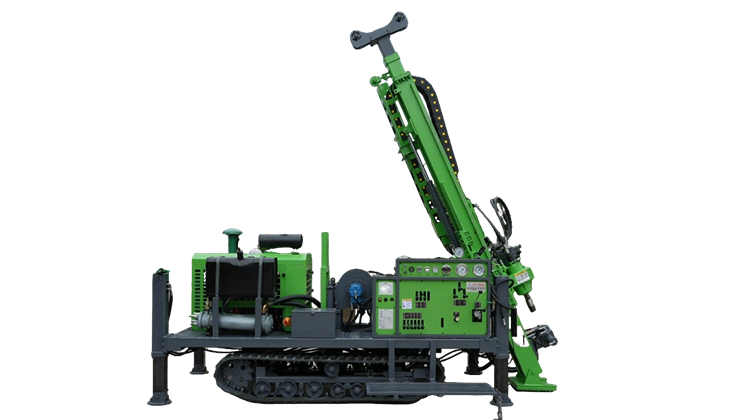

DTH vs Rotary vs Core Drilling: A Practical Guide
2026-07-16


Choose DTH drilling for borehole production in competent rock, mud rotary drilling where fluid circulation can support softer or unstable formations, and core drilling when intact geological samples are required. Confirm the choice against the borehole log, depth, diameter, casing plan and available support equipment. Here, “rotary” means mud rotary drilling; DTH and core systems also rotate the drill string.
This guide compares down-the-hole (DTH), rotary mud, and core drilling in practical terms. It explains where each method performs best, which support equipment is needed, and how to discuss the application with a rig manufacturer. For a complete equipment overview, browse Feiyang’s drilling rig range.
Quick comparison: DTH vs rotary vs core drilling
| Method | Primary purpose | Typical formations | Circulation or cutting action | Main output |
|---|---|---|---|---|
| DTH drilling | Fast borehole production in rock | Competent, hard, and fractured rock | Compressed air powers a hammer behind the bit and lifts cuttings | Open borehole and rock chips |
| Rotary mud drilling | Water wells and large-diameter holes in softer ground | Clay, sand, gravel, soft rock, and layered overburden | Rotating bit cuts formation; drilling fluid supports the hole and carries cuttings | Open borehole and circulated cuttings |
| Core drilling | Geological investigation and mineral exploration | Rock where intact samples are required | Annular bit cuts around a cylindrical sample retained in a core barrel | Continuous or interval rock core |
The table is a starting point. Depth, diameter, water conditions, borehole stability, sample requirements, environmental limits, and local operating experience can change the final choice.
How DTH drilling works
In DTH drilling, compressed air drives a pneumatic hammer located directly behind the drill bit. The piston repeatedly strikes the bit while the drill string rotates. Because impact energy is delivered at the bottom of the hole, DTH drilling can maintain effective rock-breaking performance as depth increases. Exhaust air also carries chips toward the surface.
DTH is widely used for water wells in rock, quarry holes, foundation work, anchors, and other hard-rock applications. A suitable DTH drilling rig needs the right feed force, rotation torque, pullback capacity, mast stroke, and air connections for the planned hammer and hole diameter.
Advantages of DTH drilling
- Efficient penetration in competent hard rock.
- Good hole straightness when the setup and operating parameters are correct.
- Simple observation of dry rock chips at the surface.
- Useful for water wells where rock formations dominate.
- Flexible tooling for a range of rock-hole diameters.
Limitations of DTH drilling
- Requires a correctly sized high-pressure air compressor.
- Fuel consumption can be driven by the compressor as much as the rig.
- Loose, collapsing overburden may require casing or an overburden drilling system.
- Air and dust management may be restricted at sensitive sites.
- Sample returns are chips, not intact geological core.
How rotary mud drilling works
Rotary drilling uses a rotating bit to scrape, shear, or crush the formation. Drilling fluid is pumped down the drill string and returns through the annulus, transporting cuttings to the surface. The fluid also cools the bit and helps stabilize permeable or unconsolidated formations by supporting the borehole wall and forming a filter cake.
The method is common in water-well construction, especially in clay, sand, gravel, and softer sedimentary formations. Feiyang’s water well drilling solutions include configurations for different depths, diameters, and mobility requirements.
Advantages of rotary mud drilling
- Well suited to unconsolidated and mixed overburden.
- Drilling fluid can support the borehole before casing is installed.
- Capable of relatively large bore diameters.
- Can produce smooth holes for casing and screen installation.
- Does not depend on a large air compressor for circulation.
Limitations of rotary mud drilling
- Needs water, a suitable mud pump, mixing, and a fluid management area.
- Drilling fluid properties must be monitored and adjusted.
- Penetration in very hard rock may be slower than an appropriate DTH system.
- Site cleanup and disposal of fluid and cuttings must be planned.
- Poor fluid control can affect borehole stability or well development.
How core drilling works
Core drilling uses an annular bit that cuts a circular path while leaving a cylindrical sample inside a core barrel. Depending on the system, the inner tube can be retrieved without pulling the entire rod string. The recovered core allows geologists and engineers to log lithology, fractures, alteration, mineralization, rock quality, and structural orientation.
Core drilling is primarily an information-gathering method. It is central to mineral exploration, geotechnical investigation, dam and tunnel studies, and other projects where representative samples justify the additional time and handling. Explore exploration drilling rigs and the full hydraulic core drilling rig category for typical equipment approaches.
Advantages of core drilling
- Produces intact samples for geological and engineering analysis.
- Supports detailed logging of fractures, structures, and material changes.
- Can achieve excellent sample recovery with the right barrel, bit, and operating practice.
- Provides defensible subsurface data for resource and design decisions.
Limitations of core drilling
- Usually slower and more procedure-intensive than production borehole drilling.
- Requires core barrels, inner tubes, bits, rods, fluids, and careful sample handling.
- Operators need specific skills to maximize recovery and maintain sample quality.
- Core boxes, labeling, storage, and geological logging add project steps.
Key selection criteria
1. Project objective
If the deliverable is a completed water well, DTH or rotary drilling will usually be the main comparison. If the deliverable is an intact geological sample, core drilling is normally required. Do not pay for sample quality that the project does not need, and do not substitute chip samples when engineering or exploration decisions require core.
2. Formation profile
Obtain nearby bore logs whenever possible. Thick unconsolidated overburden favors a circulation system and casing plan that protect the hole. Competent rock favors percussive DTH drilling for borehole production. Layered sites may require a combination: casing through overburden, then DTH in bedrock, or a multipurpose rig capable of air and mud drilling.
3. Borehole depth and diameter
Depth and diameter affect rod size, mast, torque, pullback, pump or compressor capacity, cuttings transport, and casing strategy. Specify both the drilled diameter and the finished diameter after casing or screen installation. For core drilling, state the required core size and the expected hole depth.
4. Sample requirement
Water well projects may only need formation cuttings and drilling response to guide construction. Mineral and geotechnical programs may require continuous core, recovery measurements, orientation, and chain-of-custody controls. The sample requirement is often the clearest dividing line between production drilling and core drilling.
5. Support equipment and utilities
DTH drilling requires compressed air matched to the hammer and operating conditions; use our water well drilling compressor pressure and airflow guide to review the matching inputs. Rotary mud drilling requires water, fluid storage, mixing, cleaning, and a compatible pump. Core drilling requires a flushing system, core-retrieval tools, and sample handling facilities. Compare the entire system, not only the drilling rig.
6. Site and environmental constraints
Consider access width, ground bearing pressure, slope, noise, dust, water availability, fluid containment, freezing conditions, altitude, and local regulations. A compact crawler may reach a site that a truck-mounted unit cannot. A dry-air method may be unsuitable where dust control is critical, while a mud system may be difficult where water supply and fluid disposal are restricted.
Can one rig perform more than one drilling method?
Some multipurpose rigs can support air DTH, mud rotary, and related techniques when equipped with suitable rotation ranges, torque, pumps, air connections, clamps, rod handling, and control functions. This flexibility is valuable for contractors working across variable geology.
However, “multipurpose” does not mean every configuration is equally efficient for every task. Confirm the working parameters for each method, not just a general compatibility claim. Tooling change time, compressor or pump size, mast stroke, rod diameter, breakout capacity, and operator training all influence field performance. See the top-drive multifunction air-and-water drilling rig category for an example of this approach.
Questions to answer before selecting a method
- Is the goal a water well, production hole, foundation hole, or geological sample?
- What formations are expected from surface to final depth?
- What are the target depth and finished diameter?
- Is intact core required, or are chips and drilling response sufficient?
- Is water available for drilling fluid and cleanup?
- What compressor pressure and air volume are locally available?
- Will unstable overburden require temporary or permanent casing?
- What are the access, transport, noise, dust, and fluid-disposal limits?
- How many meters or holes must be completed per shift or month?
- Which tooling, spare parts, and technical skills are available locally?
Frequently asked questions
Is DTH drilling faster than rotary drilling?
In competent hard rock, DTH is often the more productive borehole method. In soft or unconsolidated formations, rotary mud drilling may be more suitable because the fluid supports the hole and transports cuttings. Speed depends on the formation and the complete equipment match.
Can DTH drilling be used in sand and gravel?
Loose formations can collapse around the tool string. DTH may still be used with an appropriate casing-advance or overburden system, but conventional open-hole DTH is primarily strongest in competent rock.
Does core drilling make a finished water well?
Core drilling can identify formations and water-bearing structures, but it is normally selected for sample recovery rather than economical construction of a production well. The final well may require a different diameter, drilling method, casing, screen, gravel pack, and development process.
What information should I send to a drilling rig supplier?
Send the application, geology or nearby bore log, depth, diameter, casing plan, sample requirement, preferred method, site access, production target, available compressor or pump, destination, and support expectations.
Match the method to the required outcome
DTH excels at productive rock drilling, rotary mud drilling is highly practical in softer and unstable formations, and core drilling is the correct choice when intact subsurface evidence is the main deliverable. The best selection comes from matching geology, bore design, sample needs, support equipment, and site limits as one system. Share your parameters through the Feiyang contact page for an application-based equipment recommendation.