


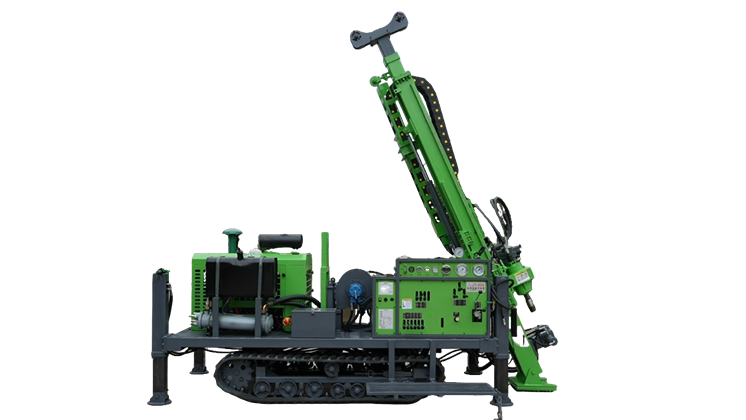

Crawler vs Truck vs Trailer Water Well Drilling Rigs
2026-10-08


Choose a crawler water well drilling rig when movement within the site is the main constraint; compare a truck-mounted rig when frequent transfers between road-accessible sites are central to the job; consider a trailer-mounted rig when a suitable towing vehicle and route are available. The carrier does not determine drilling depth or the right drilling method. Check geology, borehole diameter, tooling and support equipment separately before choosing a model.
This guide compares mobility and transport planning. For the drilling system itself, see our complete water well drilling equipment guide.
What is the difference between crawler, truck and trailer rigs?
Crawler-mounted: assess the final approach to the borehole
A crawler rig travels on tracks for positioning around the job site. It is worth comparing when the final approach or movement between boreholes makes a wheeled carrier difficult to use. Track mounting alone does not prove that a rig can cross soft ground, steep slopes or narrow entrances. Confirm operating weight, machine width, ground conditions and the manufacturer's travel limits.
Plan how the crawler will reach the project: a separate transport vehicle, loading arrangements and room to unload may be needed. Include the compressor or mud pump, rods and other equipment in this plan. The FY-350 crawler water well drilling rig is one model to review against your site requirements.
Truck-mounted: assess the whole travel route
A truck-mounted rig combines the drilling unit with a truck chassis. Compare this arrangement when the team moves frequently between sites connected by suitable roads. Check the complete vehicle's transport dimensions, loaded weight, turning space and access to the drilling position. A truck that can reach the entrance may still be unable to reach the borehole or position its supports.
Request the exact chassis and equipment configuration offered. Confirm what is carried on the truck and what requires a support vehicle. The MYC-300 truck-mounted water well drilling rig is a starting point for this comparison; the current quotation should identify the supplied configuration.
Trailer-mounted: assess the towing arrangement
A trailer-mounted rig needs a compatible towing and transport arrangement. It can be considered when the buyer already has a suitable vehicle and the planned route and site can accommodate the combination. Verify loaded trailer weight, coupling, braking arrangements, dimensions and manoeuvring space with the supplier and transport provider. Do not assume that a machine described as trailer-mounted is automatically ready for public-road towing at the destination.
Review the FY-260L trailer-mounted water well drilling rig as a product example. Ask which vehicle and transport arrangements are required for the exact package being quoted.
A practical comparison for buyers
- Several boreholes within one difficult-access site: compare crawler dimensions and travel limits, while checking that all support equipment can also reach the work area.
- Frequent moves between road-accessible sites: compare a truck-mounted package with the complete logistics of a crawler and its transporter.
- An existing towing vehicle: compare a trailer package only after confirming compatibility, loaded weights and the intended route.
- A narrow gate or confined working area: use actual transport and operating dimensions. No carrier type is automatically the smallest.
These are shortlisting criteria, not a substitute for a site assessment. The best choice is the package that can travel to the site, be set up correctly and complete the specified borehole with its supporting equipment.
Does the carrier determine DTH or mud rotary drilling?
No. Carrier type and drilling method answer different questions. The carrier concerns movement and mounting. The drilling system must match the formation and borehole requirements. A model's available methods depend on its actual configuration, rather than whether it uses tracks, a truck or a trailer.
Read our DTH, mud rotary and core drilling comparison before matching tooling. For an air-powered DTH package, use the water well drilling air compressor selection guide to prepare pressure and airflow questions. Confirm the required mud pump and circulation equipment separately for a mud rotary package.
Compare the complete delivered package
A rig-only offer and a complete drilling package are not directly comparable. Ask each supplier to list included and excluded items against the same project brief:
- Rig model, carrier or chassis, transport dimensions and operating weight.
- Compressor or mud pump specification and how it will travel to the site.
- Drill rods, hammer or bits, connections and quantities.
- Setup space, support arrangements and loading or unloading requirements.
- Spare parts, documentation and the agreed commissioning or training scope.
- Packing, delivery destination and transport responsibilities.
Compare mobilisation requirements as well as the equipment price. A lower rig-only price may exclude transport or supporting equipment that your project still needs. Request an itemised quotation rather than assuming every accessory shown in a photograph is included.
What should you send before requesting a recommendation?
- Borehole: target depth, required diameter, expected geology and any nearby borehole records.
- Access: route and site photographs, narrowest entrance, surface conditions and available setup space.
- Movement: distance and frequency of transfers, plus the vehicles or transporter already available.
- Equipment: preferred drilling method and details of an existing compressor, pump or tooling.
- Environment: altitude and expected operating temperatures.
- Delivery: destination country, port or inland destination, quantity and required delivery schedule.
For overseas projects, provide both the delivery destination and the final site conditions. Country alone is not enough to select a carrier or drilling system. Confirm local vehicle and transport requirements with the relevant provider before finalising a chassis or trailer specification.
Frequently asked questions
Is a crawler rig always better on rough ground?
No. Tracks are only one part of the assessment. Ground bearing conditions, slopes, machine dimensions, loaded weight and the manufacturer's limits still matter. The compressor, rods and support vehicles must also be able to reach the drilling area.
Can a truck-mounted rig carry the whole drilling package?
That depends on the supplied configuration and load limits. Ask for a layout and packing list showing what travels on the truck and what needs a separate vehicle.
Is a trailer-mounted rig automatically cheaper to operate?
No. Compare the towing vehicle, transport arrangements, support equipment and frequency of moves. The carrier label alone cannot establish the total operating cost.
Can two rigs with the same advertised depth replace each other?
Not necessarily. Compare the borehole diameter and conditions associated with that rating, drilling method, tooling, pullback and support equipment. Confirm the exact configuration for the planned borehole.
Match the carrier to your project
Browse the water well drilling rig range, then send your borehole and transport requirements for a quotation. Include site photos and existing vehicle details so the carrier and the complete equipment package can be reviewed together.